

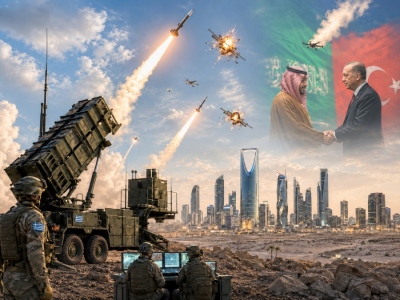
We are no longer talking about "defensive diplomacy." We are talking about war. The Greek Patriot systems deployed to Saudi Arabia have been involved for the first time in real operations, shooting down hostile UAVs. And the question that arises is simple… What are Greek Patriot missiles doing in Saudi Arabia at a time when the Aegean is boiling? Because Greece is not going through a period of defensive relaxation. Turkey continues its aggressive rhetoric and provocations in the Aegean. The Middle East is in constant turmoil. Drones have evolved into a primary weapon of modern warfare. And Athens has chosen to allocate a Greek Patriot battery to Saudi Arabia to protect Saudi oil facilities belonging to ARAMCO and to reinforce a "show of strength" on behalf of the Mitsotakis government.
And suddenly the Patriots were needed for real
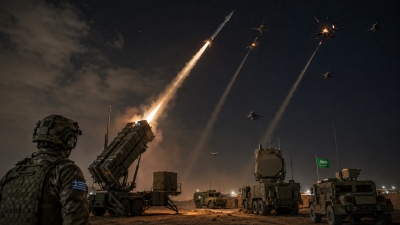
In the early morning hours of Thursday, August 27, 2026, the Greek Guided Missile Battery PATRIOT of ELDYS-A entered a real operational engagement. Hostile UAVs were detected. The Greek battery engaged and fired three Patriot missiles. The targets were intercepted in cooperation with the air defense systems of the Kingdom of Saudi Arabia. This was not just another military public relations activity; rather, the Greek Patriots were utilized in an actual combat incident. And now it is demonstrated in practice how critical the Greek battery transferred to Saudi Arabia really is. And obviously for the Aramco refineries, with which Greece maintains significant business ties.
Critical Aramco infrastructure in Yanbu and Jazan
Houthi targets include critical energy infrastructure in Saudi Arabia, with the areas of Yanbu and Jazan acquiring particular strategic importance due to the concentration of major refineries, processing units, and oil storage and distribution facilities. Behind this specific infrastructure stands Saudi Aramco, the state-controlled energy giant of Saudi Arabia and one of the largest oil companies worldwide. The Yanbu region, situated on the shores of the Red Sea, constitutes one of the Kingdom's most vital energy and industrial hubs.
Yanbu: Three major refineries
Three major refineries operate in the broader region of Yanbu, together possessing a massive production capacity and serving as a key link in Saudi Arabia's energy chain. The Yanbu Refinery, wholly owned by Saudi Aramco, began operations in 1983 and holds a capacity of approximately 230,000 barrels of crude oil per day. The plant produces fuels and other raw materials to cover the country's energy requirements, while in recent years it has been modernized with digital systems and automation technologies. SAMREF, an equal-share joint venture between Saudi Aramco and ExxonMobil, holds particular significance as well. The refinery has operated in Yanbu since 1984. Initially designed to process roughly 263,000 barrels of Arabian light crude daily, its capacity has now increased to more than 400,000 barrels per day. It produces gasoline, diesel, aviation fuel, propane, marine fuel oil, and sulfur, among other products, while further investments are under consideration to transform it into an integrated refining and petrochemical complex. The third major refinery is YASREF, a joint venture between Saudi Aramco and China's Sinopec. It is a full-conversion refinery with a capacity of approximately 400,000 barrels per day, processing primarily heavy Arabian crude to produce transport fuels and other high-value products. The facility represents one of the most vital industrial units in Yanbu Industrial City, covering an area of approximately 5.2 million square meters.
Jazan: The second major energy front
If Yanbu serves as one of the largest energy centers in western Saudi Arabia, Jazan constitutes another critical piece of the Kingdom's energy infrastructure. The area does not feature the same concentration of independent refineries as Yanbu. However, it hosts a massive integrated energy complex belonging to Saudi Aramco, centered around the Jazan Refinery, with a capacity of approximately 400,000 barrels of crude daily. The refinery processes mostly heavy crude, producing gasoline, ultra-low sulfur diesel, benzene, and other products. Yet its importance is not limited to refining. The complex includes aromatics and petrochemical units, storage, processing, and power generation facilities, making Jazan one of Saudi Arabia's key integrated energy hubs.
The massive gasification and power complex
Adjacent to the refinery stands the Jazan Integrated Gasification and Power Complex, one of the largest integrated gasification and power generation complexes globally. The complex utilizes heavy refinery residues, converting them into synthetic gas to produce electricity, hydrogen, and other industrial gases. Its installed capacity approaches 3.8 GW, supplying the refinery's operational needs while feeding the surplus into the national power grid. It operates essentially as an integrated industrial chain connecting refining, power generation, and petrochemical production.
The importance of the port
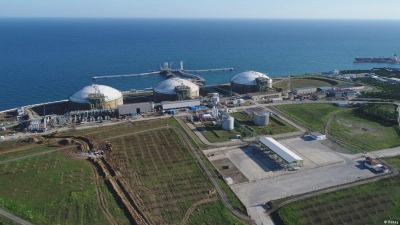
Port infrastructure represents a critical component of the Jazan facility. The complex features a dedicated port and marine terminal for receiving crude oil and dispatching finished products. There are three tanker berths, a bulk sulfur loading berth, and an offshore SPM mooring unit. In this manner, the energy complex links directly with international maritime routes across the Red Sea. Simultaneously, the area houses crude and fuel storage tanks, hydrogen and industrial gas production units, water and sulfur treatment facilities, alongside pipeline and power networks. All these components operate as a unified system built around Aramco's energy complex.
Why Yanbu and Jazan hold strategic importance
The geography of both regions explains the interest they draw in an environment marked by heightened drone and missile attacks. Yanbu and Jazan are located along the Red Sea coast, featuring extensive refining, storage, power generation, and maritime transport facilities. Consequently, these are not merely individual oil refineries. They represent entire energy networks whose disruption could impact not only Saudi Arabia's domestic market, but also global energy flows. And this is precisely what makes their defense so critical. In a region where UAVs have evolved into a primary tool of military pressure, the air defense of these facilities acquires paramount importance. This is where the Greek presence in Saudi Arabia fits in, with the Greek Patriot battery participating in protecting the Kingdom's critical infrastructure. Following the actual combat engagement of Greek Patriots against hostile UAVs, safeguarding these facilities ceases to be a theoretical exercise. Saudi Arabia's energy heart now faces a new reality: drones and missiles can turn vast energy facilities into strategic targets.
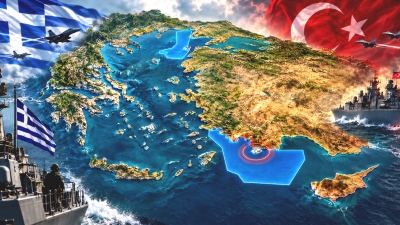
The problem is that the Aegean lies on the other side
This is where the Greek paradox begins, as Greece faces a principal and enduring geopolitical rival: Turkey. Turkey is investing heavily in UAVs, missiles, drones, and new warfare technologies. Meanwhile, Greece is sending Patriot systems to Saudi Arabia. Until today, the government could claim that this was a mission of defense cooperation yielding significant diplomatic benefits for Athens. Following today's engagement, however, the situation changes. Because the Patriots are not merely present in Saudi Arabia—they are actively operating.
Turkey enters the game through a different door
Turkey offers Riyadh a completely different package. Over recent years, the country has emerged as a major producer and exporter of defense equipment. Drones, missile systems, electronics, naval systems, and the broader Turkish defense industry now form a substantial part of Ankara's foreign economic policy. This is of particular interest to Saudi Arabia. Vision 2030 is not merely an economic diversification initiative to reduce oil dependence. It represents an effort to build a domestic industrial and technological foundation. The defense sector forms a cornerstone of this endeavor. Riyadh seeks to expand local defense manufacturing, attract technology and foreign investments, and generate high-skilled jobs. Turkey can offer precisely these capabilities. Hence, the Saudi Arabia–Turkey relationship is not purely military. It carries a powerful industrial and investment dimension. And this is the specific point where Greece must pay close attention.
And there is one more "detail"
Saudi Arabia no longer acts in isolation. On August 7, 2026, it signed a joint defense agreement with Turkey and Pakistan. The accord provides for enhanced defense cooperation, and according to official statements, an attack on any one of the three states will be considered an attack against all. At the very same time, Greece has deployed Patriots to strengthen the Kingdom's air defense. The picture is paradoxical, to say the least: Greece supplies valuable anti-aircraft firepower to protect Saudi Arabia, while Saudi Arabia deepens its military ties with Turkey. Saudi Arabia is obviously not an enemy of Greece, but Athens cannot afford to ignore these new balances of power.
What exactly has the government calculated?
The core issue is not whether defense cooperation should exist with Saudi Arabia; naturally, it should. The real question is different: how long can Greek defense forces afford to deploy critical systems abroad? And even more crucially, what happens if Greece needs them at home? While a Greek Patriot battery in Saudi Arabia is useful for Riyadh, Turkey remains present in the Aegean Sea. And Greece is a nation that ought to maintain its own air defenses at the highest state of readiness.
The message of the three missiles
Today's engagement offers a secondary takeaway as well: Greek military personnel proved they can operate the Patriot system under actual combat conditions. This is significant, because Patriot batteries are not a "diplomatic tool"—they are warfighting weapons. And every such weapon system removed from Greece must be replaced—not on paper, and not through future procurement programs. The government needs to clarify: how many Greek Patriot batteries are currently deployed outside Greece? What is the current operational availability of Greek air defense? How has the risk to national defense been calculated? And above all, if a serious crisis erupts tomorrow in the Aegean, will Greek Patriots be where they belong? Because today, August 27, 2026, Greek Patriots proved that they can indeed be needed. They were simply needed in Saudi Arabia, while Greece stands face to face with Turkey. Athens cannot afford to take national security for granted.
www.bankingnews.gr







Σχόλια αναγνωστών